Sunday, September 16, 2007
More AirBrush Fun
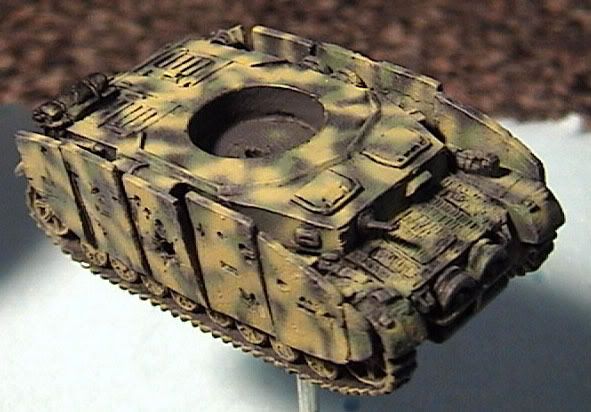
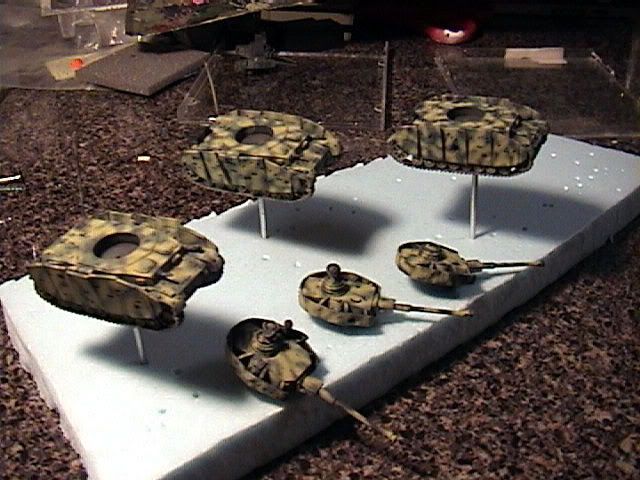
I've been playing with the airbrush again, and I think I'm getting a little better with it. I've started using Tamiya thinner to go with Tamiya paints, and I can get a much better edge, and less clogging, with this mixture. I did a few StuGs, too, but I don't have pics of them yet. The details arn't done yet, but here's how the camo came out on a few Panzer IVs:


Chinese Army progress
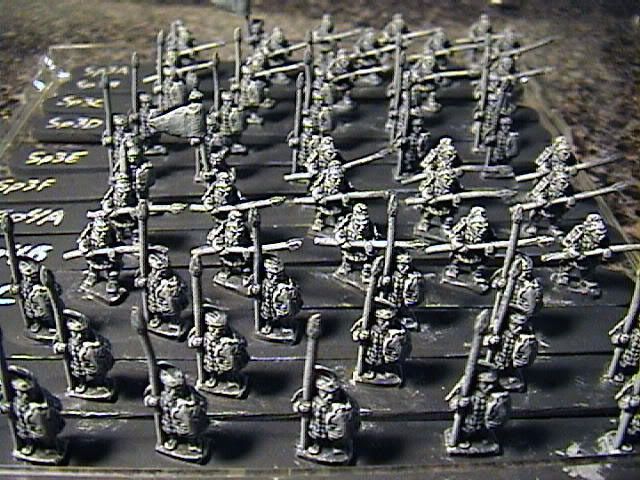
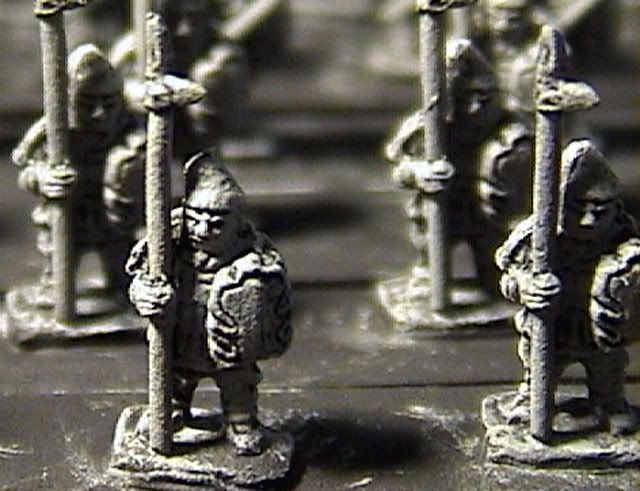
Well, this has been quite the little distraction! Honestly, it hasn't been any fun, either. There is no room for art at this scale, just process and repitition. Still, I've got this step done: the entire army is modeled (what little modeling there was to do) and dry-brushed a very light grey. All I'm going to do for painting is to stain them with color and then some simple bases. I want to play the game, but it just isn't worth much modeling time. So here's what the Thousand Yellow Devils are looking like, still mounted to their painting sticks:


Mighty (Empires) Finished Game
Well, that's out of the way!

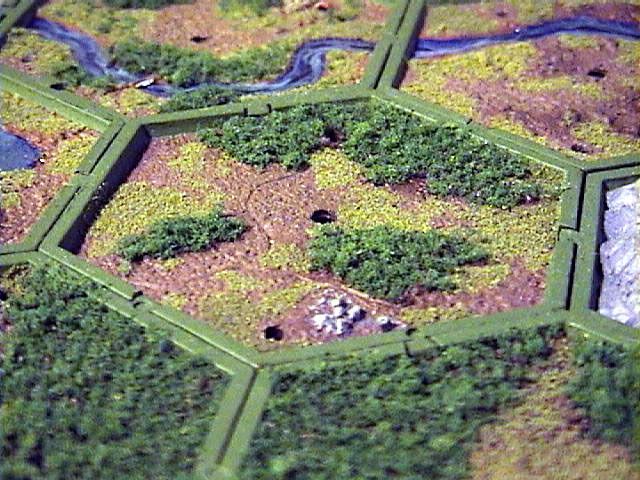
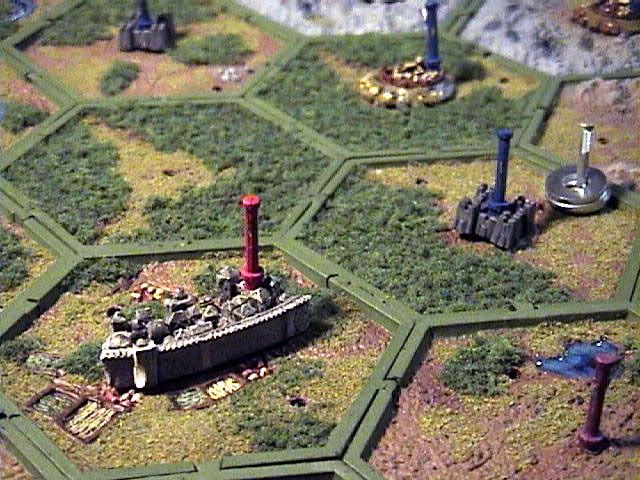
The map is all flocked up and stuff. I used two thicknesses of flock, one for the fields of grass and another, thicker flock to represent big tall trees, "forrests" in game terms.

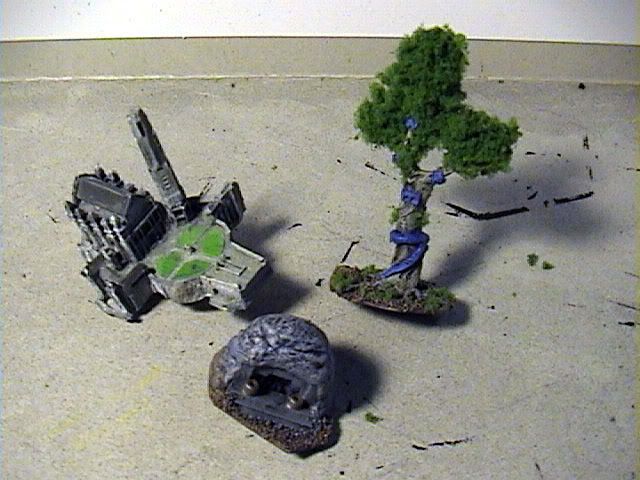
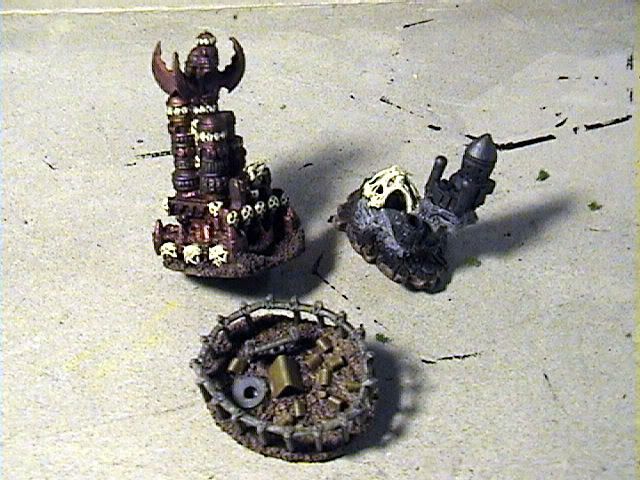
I also made up a crap-load of markers for the game. Most of them are pretty boring, but I did like what I cranked out for capitols for each of the player nations:


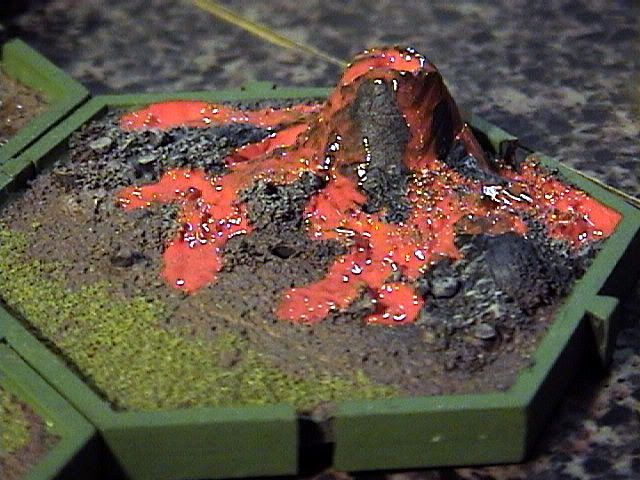
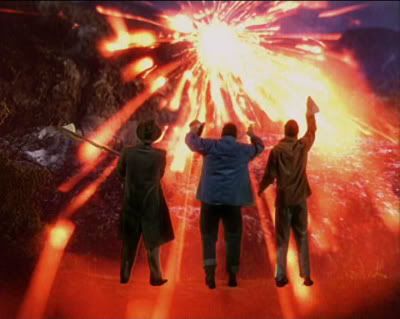
And, just for fun, I made a volcano!

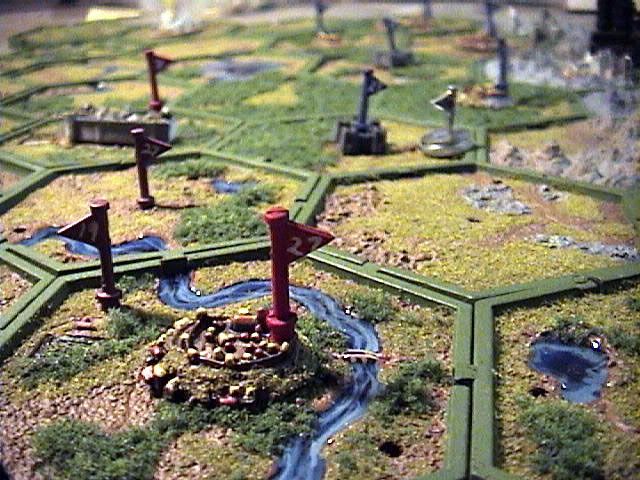
Here's a few shots of the trial game I played with myself, just to see how things would work:


Now all I gotta do is get those slack-asses to get together and start playing the fucking thing. I spent enough time on it.
The map is all flocked up and stuff. I used two thicknesses of flock, one for the fields of grass and another, thicker flock to represent big tall trees, "forrests" in game terms.
I also made up a crap-load of markers for the game. Most of them are pretty boring, but I did like what I cranked out for capitols for each of the player nations:
And, just for fun, I made a volcano!
Here's a few shots of the trial game I played with myself, just to see how things would work:
Now all I gotta do is get those slack-asses to get together and start playing the fucking thing. I spent enough time on it.
FoW -- Field Fortifications
After getting my ass handed to me a while back over a buddie's mine field (my boys just would not cross that thing) I figured it was time to invest a little time in some field fortifications. Since I built these almost exactly as Battle Front have suggested both on line and in print I won't go into a length discussion of how they were made, I'll just hit the high points.

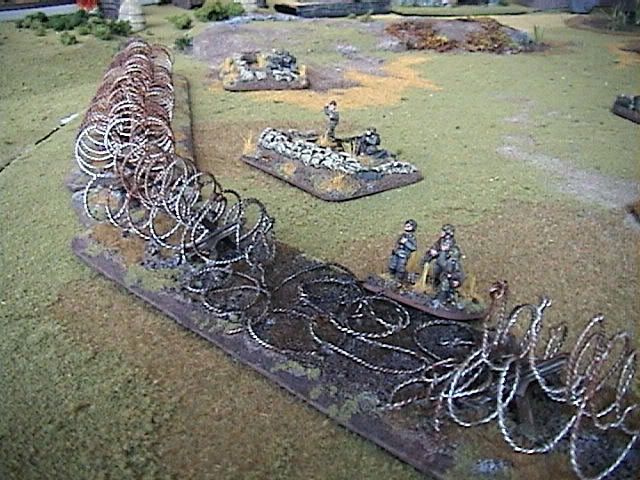
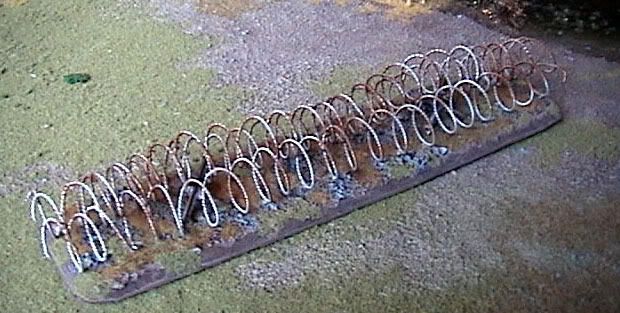
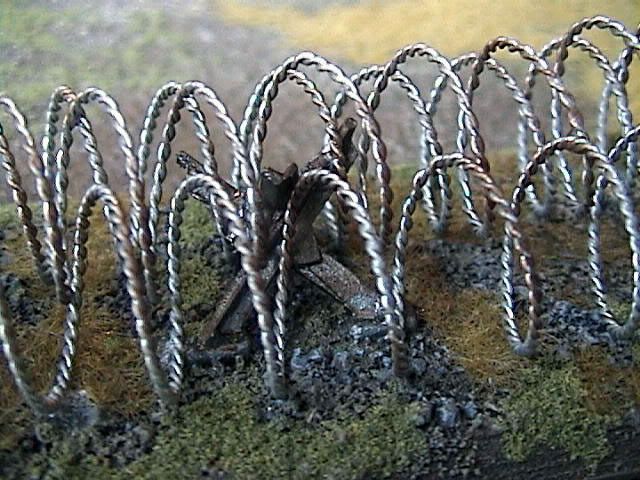
Each base is 2 x 8 inches, just like the rules say they should be, set on masonite bases I cut from some left-overs. Since I don't own a real drill, I twisted the wire in my Dremmel. If you try it that way, be carefull -- you will snap some with anything above minimum speed on those things.

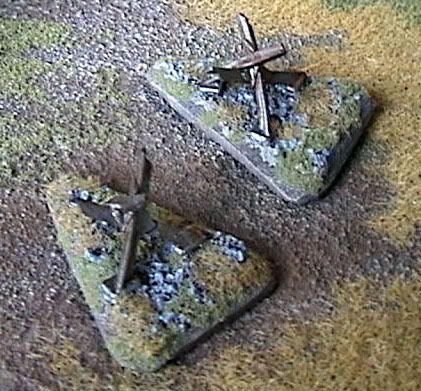
I decided to go all-out (no, not me!) and bought a pack of their beach obstacles. Each base has two of the hedge hogs used as supports...

... and to make some handy corner bits:

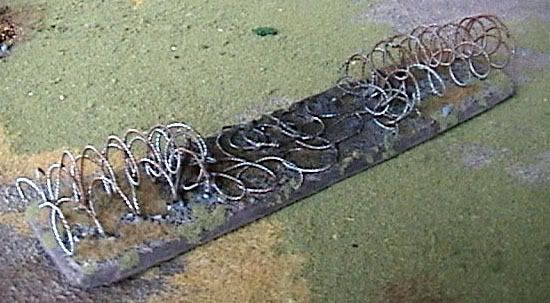
I had a few twised strands that didn't quite have the length to make a full piece (remember what I said about twisting wire at 20,000 RPM?) so I cranked out a "cleared" section:

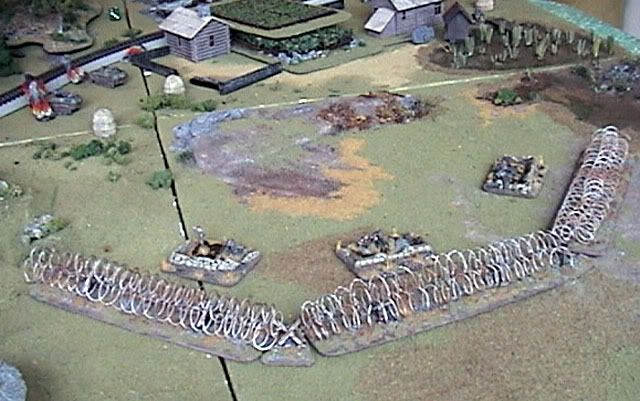
All told, I made enough barbed wire to supply a standard Pioneer Platoon in Flames of War. If I want to do any real fortification type games, I'll need a lot more, but for now this should be pleanty (I wish I'd used all of this in the tournament I was at yesterday...)

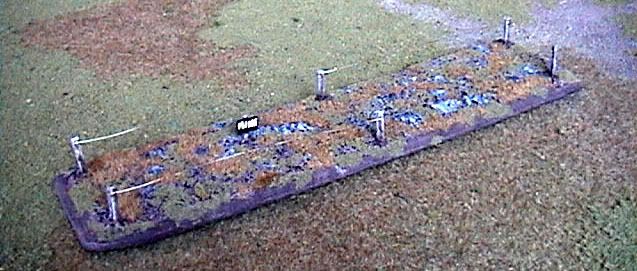
I also made up a mine field to slow tanks down (when I'm not a dumb-ass and leave them a nice big fat gap to roll through...)

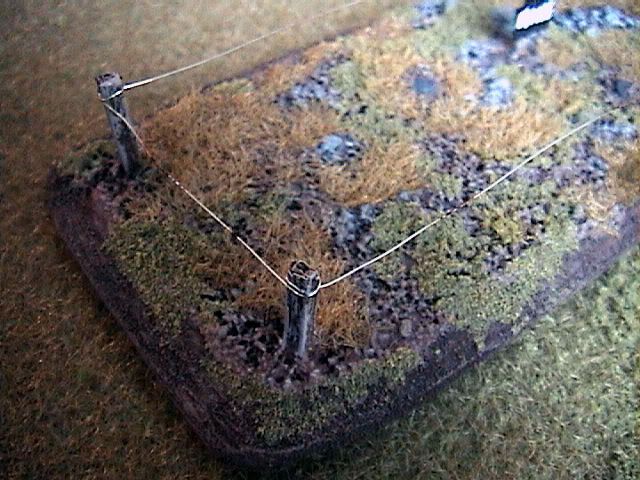
It is just a simple base with match sticks cut down for the corner supports. I strung a thin wire around the whole thing, wrapping it around each post and glueing it in place with super glue.

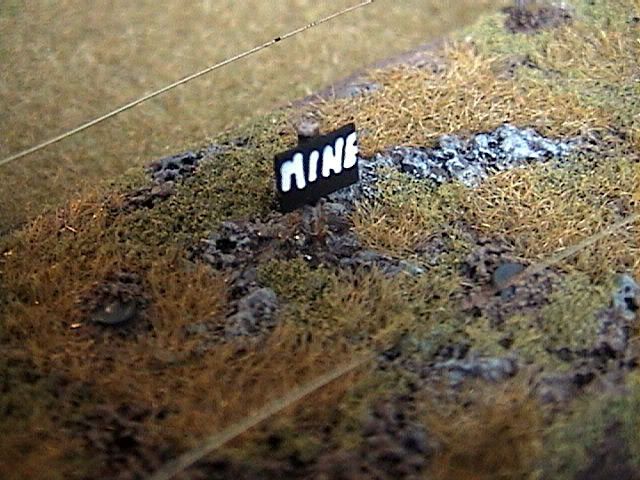
And it just wound't be a mine field without a warning sign. You can also see one of the exposed mines, made from a bit of plastic punched out with a hole-punch and a bit of round sprew glued on top.

Before everything was put together, they were covered in my standard basing paste (coffee, water, and white glue) and painted up to match my table. Bits of grass finished the bases, and then I glued on the wire. The wire was quickly rusted with some chestnut ink shot from the air brush -- I didn't even bother to paint the wire as metal, since it already was, well, metal. The burnt color in the cleared section of wire was also done with a quick air brushed shot of black.
Each base is 2 x 8 inches, just like the rules say they should be, set on masonite bases I cut from some left-overs. Since I don't own a real drill, I twisted the wire in my Dremmel. If you try it that way, be carefull -- you will snap some with anything above minimum speed on those things.
I decided to go all-out (no, not me!) and bought a pack of their beach obstacles. Each base has two of the hedge hogs used as supports...
... and to make some handy corner bits:
I had a few twised strands that didn't quite have the length to make a full piece (remember what I said about twisting wire at 20,000 RPM?) so I cranked out a "cleared" section:
All told, I made enough barbed wire to supply a standard Pioneer Platoon in Flames of War. If I want to do any real fortification type games, I'll need a lot more, but for now this should be pleanty (I wish I'd used all of this in the tournament I was at yesterday...)
I also made up a mine field to slow tanks down (when I'm not a dumb-ass and leave them a nice big fat gap to roll through...)
It is just a simple base with match sticks cut down for the corner supports. I strung a thin wire around the whole thing, wrapping it around each post and glueing it in place with super glue.
And it just wound't be a mine field without a warning sign. You can also see one of the exposed mines, made from a bit of plastic punched out with a hole-punch and a bit of round sprew glued on top.
Before everything was put together, they were covered in my standard basing paste (coffee, water, and white glue) and painted up to match my table. Bits of grass finished the bases, and then I glued on the wire. The wire was quickly rusted with some chestnut ink shot from the air brush -- I didn't even bother to paint the wire as metal, since it already was, well, metal. The burnt color in the cleared section of wire was also done with a quick air brushed shot of black.
Weird War II -- SciFi German Death Rays
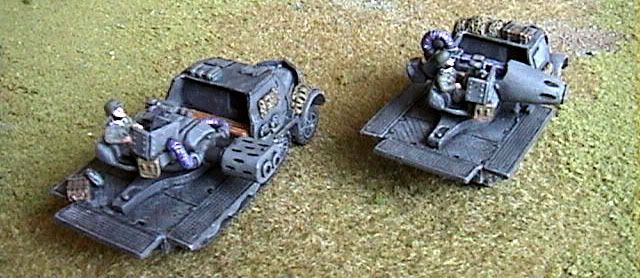
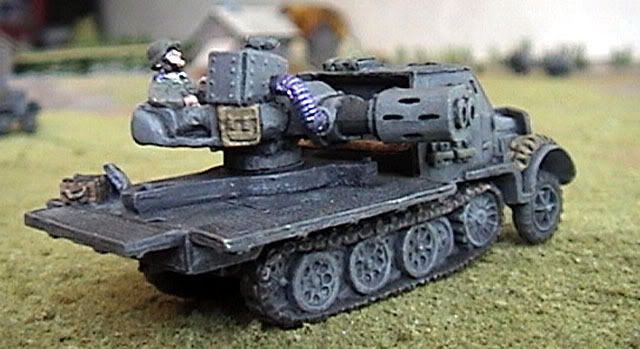
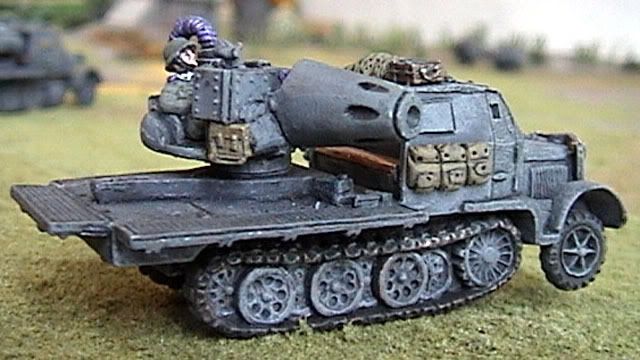
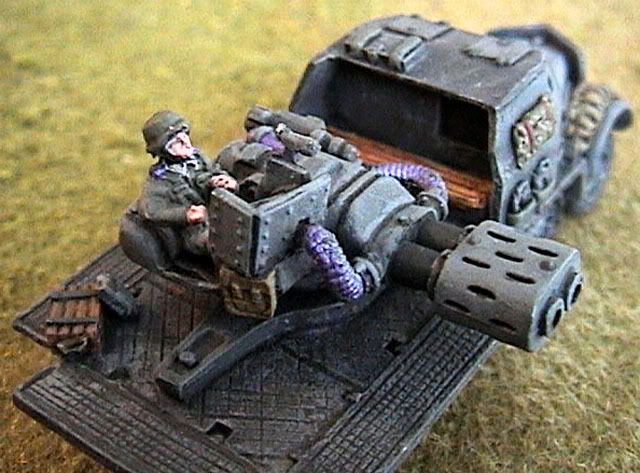
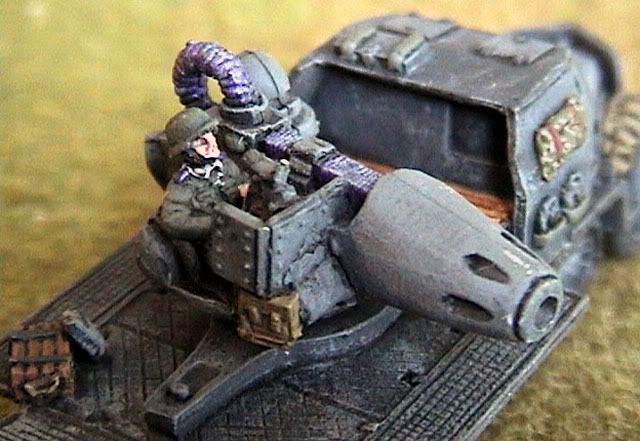
Based on reverse-engineered technology salvaged from craft left-over from the 1938 Martian invasion, the German military first began field-trials of their various Death Ray weapons in late 1943. By mid-1944 units began to receive these weapons in limited quantities, typically with a single unit receiving a mix of weapon types. Fitted to existing halftrack mounts, these weapons were issued to anti aircraft units, though they were often intended for ground attack uses. Here we see both a Heat Ray and a plasma weapon of some type:

Ev
The Heat Rays were very popular with the troops and made excellent area-denial weapons. Effective in the anti-infantry role, when fired the weapon spewed forth a shower of white-hot sparks, instantly vaporizing organic tissues. The victim's remains are deposited on the ground as a roughly man-shaped lump of white powder. An interesting side-effect of extensive use of the weapon is a localized magnetic field which can knock out wired and wireless communications and temporarilly magnetize clocks and compases, rendering them useless for a short time.


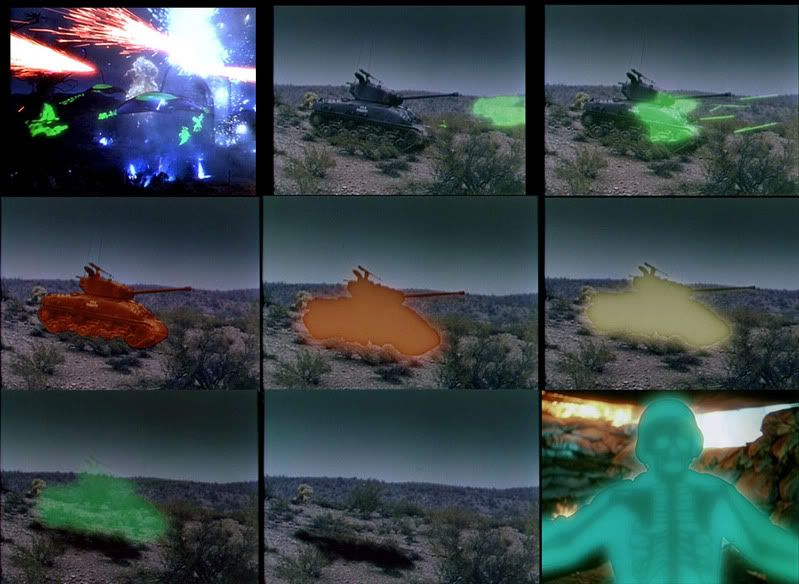
The plasma weapon, referred to by the troops simply as a "death ray," is a more complicated -- and less reliable -- design, but it is the far more potent of the two weapons. Its science is a secret closly guarded and seldom explained by the scientists of the Third Reich, but it somehow breaks down the atomic forces holding molecules together. Any object hit by these glowing green globs simply seases to exist. Tanks glow for a moment before they disapear. Humans freeze in place, their skeleton briefly shadowed by their radioactive flesh, before they also vanish.


I built these models on a whim on afternoon. Based on Battlefront armoured AA halftracks (it is two vehicles, with different putty-made stowage, but I wasn't consistant when I took the pictures), the weapon mounts are removable, allowing the vehicles to return to standard duty.

The guns themselves are built up from old Games Workshop 40K heavy weapons. In this case I used a multi-melta from a Space Marine land speeder, and a plasma cannon from... somewhere (maybe Imperial Guard? I really don't remember.) The gunners are Battlefront side-car riders seated on cut-down Old Glory side cars, with some rivited plate armour salvaged from some old GierKrieg models. The controlls are disused gun sights, and the back sides were detailed with whatever crap from the bitz box looked right, mostly Space Marine jet pack and bolter parts.

Eventually I'll come up with some rules for these things as part of mysooner-or-later-but-probably later Weird War Two project.
Ev
The Heat Rays were very popular with the troops and made excellent area-denial weapons. Effective in the anti-infantry role, when fired the weapon spewed forth a shower of white-hot sparks, instantly vaporizing organic tissues. The victim's remains are deposited on the ground as a roughly man-shaped lump of white powder. An interesting side-effect of extensive use of the weapon is a localized magnetic field which can knock out wired and wireless communications and temporarilly magnetize clocks and compases, rendering them useless for a short time.
The plasma weapon, referred to by the troops simply as a "death ray," is a more complicated -- and less reliable -- design, but it is the far more potent of the two weapons. Its science is a secret closly guarded and seldom explained by the scientists of the Third Reich, but it somehow breaks down the atomic forces holding molecules together. Any object hit by these glowing green globs simply seases to exist. Tanks glow for a moment before they disapear. Humans freeze in place, their skeleton briefly shadowed by their radioactive flesh, before they also vanish.
I built these models on a whim on afternoon. Based on Battlefront armoured AA halftracks (it is two vehicles, with different putty-made stowage, but I wasn't consistant when I took the pictures), the weapon mounts are removable, allowing the vehicles to return to standard duty.
The guns themselves are built up from old Games Workshop 40K heavy weapons. In this case I used a multi-melta from a Space Marine land speeder, and a plasma cannon from... somewhere (maybe Imperial Guard? I really don't remember.) The gunners are Battlefront side-car riders seated on cut-down Old Glory side cars, with some rivited plate armour salvaged from some old GierKrieg models. The controlls are disused gun sights, and the back sides were detailed with whatever crap from the bitz box looked right, mostly Space Marine jet pack and bolter parts.
Eventually I'll come up with some rules for these things as part of mysooner-or-later-but-probably later Weird War Two project.
Thursday, August 23, 2007
Virgil and his Wikiscanner
You've probably heard all about the wikiscanner and how it is (at least in the context of wikipedia) getting corporate panties in a well-deserved public twist. I think it rules. It was also built by someone who was in the same not-a-frat as I was in school, so I gotta link to my boy on this one.
http://www.virgil.gr/
If you have no idea what I'm talking about, like Colbert sum it up for ya:
http://www.youtube.com/watch?v=CdtBGK-i8lw
http://wikiscanner.virgil.gr/
http://www.virgil.gr/
If you have no idea what I'm talking about, like Colbert sum it up for ya:
http://www.youtube.com/watch?v=CdtBGK-i8lw
http://wikiscanner.virgil.gr/
Monday, August 20, 2007
Subscribe to:
Posts (Atom)